

Solar gate operators can be an excellent solution for automated gates where AC power is unavailable or difficult to bring to the gate. But a common misconception is that converting a gate operator to solar is simply a matter of connecting a solar panel.
A properly designed solar gate system requires more consideration. The gate itself, operator model, expected number of cycles, battery capacity, safety devices, access-control accessories and available sunlight can all affect how much energy the system and how much solar capacity is needed to keep the batteries charged.
In other words, there is no single package that is right for every gate installation.
How a Solar Gate Operator System Works
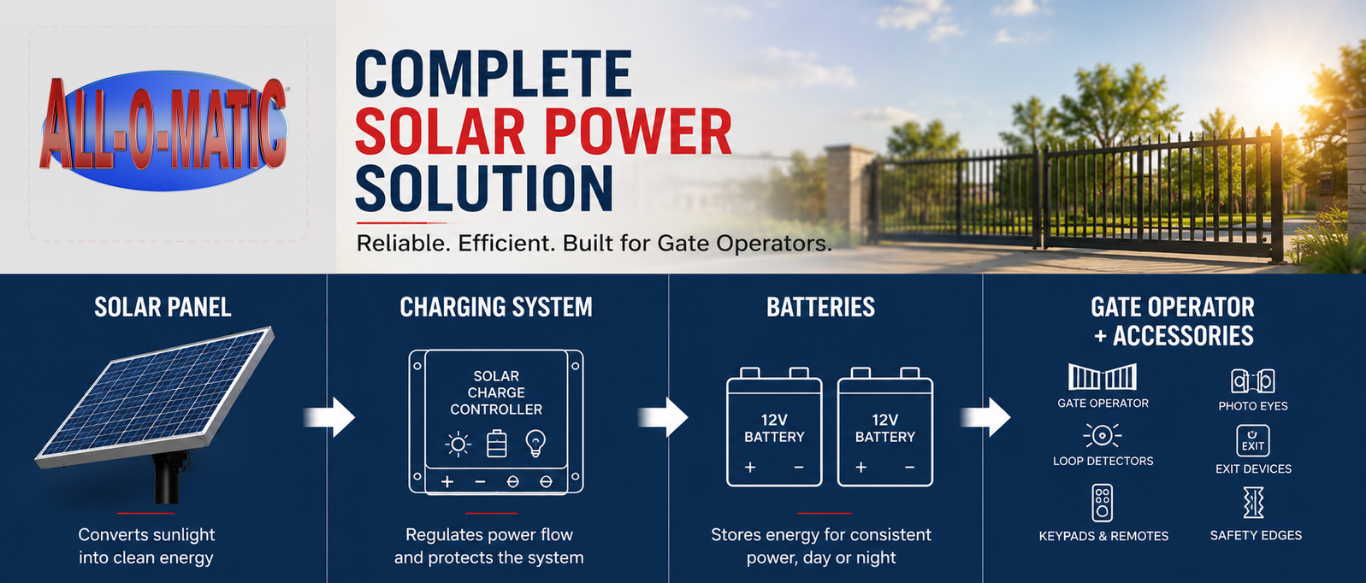
In a typical AC-powered installation, the gate operator received power from the electrical service and uses its batteries primarily to backup operation. A solar installation is different: the solar panel becomes the source used to replenish energy stored in the batteries.
SOLAR PANEL -> CHARGING SYSTEM -> BATTERIES -> GATE OPERATOR + ACCESSORIES
For the system to operate reliably, the solar system needs to replenish the energy consumed by the operator and everything connected to it. That makes solar sizing an energy-budget question, not simply a matter of choosing a panel.
Understanding All-O-Matic’s Solar Gate Operators
All-O-Matic DC gate operators normally include two 12V 7Ah batteries, creating a 24V system.
For a solar configuration, the AC power supply is removed and the standard batteries are replaced with two 12V 14Ah batteries.
For operators equipped with the ALL-BLDC-PRO control board, the onboard solar regulator uses MPPT technology and supports up to 80 watts of solar capacity. The manual specifies a minimum 24VDC 40-Watt solar panel.
Applications requiring more than 80 watts of solar power require an external charge controller/regulator.
These specifications should not be interpreted to mean that a 40-watt panel and two 14 Ah batteries will meet the requirements of every installation.
How Many Cycles Will the Gate Run?
Daily gate activity is one of the major considerations when buying a solar gate operator.
The ALL-BLDC-PRO manual provides a useful baseline: with two 12V 14ah batteries, a receiver and two monitored entrapment devices, the operator can provide approximately 20 cycles per day.
The estimate is based on a particular configuration. A residential gate operating several times per day has very different energy requirements form a commercial gate operating dozens of times per day. As cycle count increases, so does the amount of energy that must be replenished by the solar charging system.
Gate Design and Mechanical Condition Matter
The physical characteristics of the gate can significantly affect how much work the operator must perform. Gate weight and length are important, but they do not tell the entire story.
For a slide gate, consider the condition and size of the wheels, track alignment, number of wheels and overall rolling resistance. On a cantilever gate, roller condition, alignment and adjustment can affect how freely the gate travels. A gate with excessive mechanical resistance requires the operator to work harder during every cycle.
For a swing gate, several factors should be evaluated:
- Gate length and overall size – A longer gate creates greater leverage and can require more effort to start, stop and control.
- Gate construction – Picket size, frame size and the overall construction of the gate contribute to its weight and operating characteristics.
- Open versus sheeted construction – An open-picket gate allows considerably more air to pass through it than a solid or sheeted gate.
- Wind exposure – A sheeted swing gate can effectively become a large sail on windy days. The operator must work against that wind load when opening or closing the gate.
- Hinge condition – Worn, damaged, dry, undersized or poorly aligned hinges can add resistance that the operator must overcome every cycle.
- Gate alignment – A sagging or improperly aligned gate can require substantially more force to move.
- Grade and slope – A swing gate operating on a flat surface behaves differently form one opening uphill. The operator may have to lift or move the gate against the grade during part of its travel.
The important point is that two gates with similar dimensions and weight may place very different demands on the same operator.
A properly operating gate should move freely throughout its complete travel. Before determining solar requirements – or troubleshooting poor solar performance – the mechanical condition and movement of the gate should be evaluated.
Don’t Forget the Accessories
This is one of the easiest parts of a solar calculation to overlook. A modern automated gate may have considerably more connected to it than the solar gate operator itself.
- Monitored photo eyes
- Safety edges
- One or more loop detectors
- Radio receivers
- Keypads and access-control systems
- Telephone entry systems
- Cellular or network-connected devices
- Virtual loop systems
Each device adds electrical load.
For example, All-O-Matic’s PRIME VD1 and PRIME VD2 loop detectors draw approximately 10 mA, while the RED EYE 2 photo eye draws approximately 30 mA.
Those numbers may appear small compared with the current required to operate a gate, but there is an important difference: some accessories remain powered continuously while the operator motor only runs while the gate is moving.
As additional accessories are added, their combined standby consumption can become an important part of the system’s total daily energy requirements. That is why knowing the number of gate cycles alone is not enough to properly evaluate a solar application.
Battery Capacity Is Part of the System
Solar panels generate energy, but the batteries store the energy that the solar gate operator uses.
All-O-Matic’s standard solar configuration increases battery capacity from the standard pair of 12V 7Ah batteries to a pair of 12V 14Ah batteries.
For heavier-use applications, the ALL-BLDC PRO manual recommends upgrading to larger batteries. Battery capacity becomes particularly important when the gate must continue operating during periods when solar production is reduced.
ENERGY GENERATED -> ENERGY STORED -> ENERGY CONSUMED
Increasing only one component does not necessarily correct an improperly sized system.
Available Sunlight Matters
A 40-watt solar panel does not necessarily produce the same amount of usable energy at every installation.
Solar production can be affected by:
- Geographic location
- Panel orientation
- Panel angle
- Shading from trees, buildings or other structures
- Seasonal changes
- Cloud cover and weather
For best solar exposure, All-O-Matic recommends installing the solar panel facing south at approximately a 30-degree angle. Panel placement should also avoid shading from trees, buildings or other structures.
Panel placement should be considered during the initial site evaluation, not after the gate operator has already been installed.
When Is an External Charge Controller Needed?
The ALL-BLDC PRO’s onboard MPPT regulator supports solar configurations up to 80 watts.
When an application requires more than 80 watts of solar capacity, All-O-Matic specifies the use of an external charge controller/regulator.
With an external solar system, the batteries connect directly to the operator’s battery input and battery capacity should be selected according to the requirements of the application.
The manual also notes:
- 12VDC solar panels can be wired in series to create 24VDC.
- 24VDC solar panels can be wired in parallel when used with the appropriate external solar configuration.
Applications using multiple solar panels require proper wiring and charging-system design.
Questions to Ask Before Selecting a Solar Gate Operator
Rather than beginning with “What size solar panel do I need?”, an installer should first understand the complete application:
- What are the gate’s weight and length?
- Does the gate move freely throughout its entire travel?
- Approximately how many cycles per day are expected?
- Which monitored entrapment devices will be installed?
- How many loop detectors will be used?
- What radio receiver or access-control equipment will be connected?
- Are there telephone, cellular, network or other continuously powered devices?
- What is the current draw of those accessories?
- What solar exposure is available at the installation?
The answers can significantly change the solar requirements.
The Bottom Line
A solar gate operator should be approached as a complete electrical system rather than simply an operator connected to a solar panel.
The operator, gate, batteries, solar panels, safety devices and access-control equipment all contribute to how the system performs.
Understanding the application’s daily energy consumption and available solar production helps determine whether the standard solar configuration is appropriate or whether additional battery capacity, solar capacity or an external charge controller should be considered.
For solar applications, All-O-Matic recommends evaluating the complete installation – including the operator model, gate specifications, expected daily cycles and connected accessories – before selecting the solar configuration.
0 Comments